Working Out What You Actually Like
 By Jessica · Founder · Last updated

Working out what you like is a process of changing one variable at a time — pressure, rhythm and location — over several unhurried sessions, and keeping a short note of what worked. It takes weeks rather than one evening, and nobody was ever taught it.
- Most UK adults were never taught this because school-based Relationships, Sex and Health Education is built around consent, contraception and safety rather than pleasure or body literacy.
- Treat pressure, rhythm and location as three separate variables and change only one of them at a time, or you will never know which change made the difference.
- Indirect contact — through a layer of fabric, or slightly to one side — is a legitimate preference in its own right, not a stepping stone towards direct contact.
- A single session tells you more about your mood, tiredness and privacy that evening than it does about your actual preferences, so give it five or six sessions across a few weeks.
- A three-line note after each session — what you changed, what you noticed, what you would repeat — turns scattered impressions into a short specification you can act on.
- Preferences are easiest to share as plain present-tense instructions such as "slower and lighter, slightly to the left", offered outside the moment rather than during it.
1Why nobody taught you this
Nobody taught you how to know what you like because the education most UK adults received was built around avoiding harm, not understanding pleasure. Relationships, Sex and Health Education became statutory in England’s secondary schools from September 2020, and the Department for Education’s guidance frames it around consent, contraception, healthy relationships and online safety. Preference and body literacy sit outside that remit.
So the gap is structural, not personal. You were given a reasonable grounding in what can go wrong and almost nothing on what feels good.
The result is that a lot of people reach adulthood with a vocabulary for risk and none for preference. That makes this feel like a question you should already have answered, which is precisely why it never gets asked out loud.
Why “everyone else already knows” is a false impression
What people share publicly is confidence, not method. Confidence is easy to perform and preference is slow to learn, so the visible version of this is always more certain than the private one.
A fair amount of what circulates as common knowledge is simply inaccurate, and we unpick the most stubborn examples in 8 Sex Toy Myths That Need to Go. Clearing those out first stops you testing somebody else’s bad assumption and then concluding that the problem is you.
Starting from zero is a perfectly fair starting point
You do not need prior experience, a partner, or any equipment to begin. You need privacy, an unhurried hour, and a willingness to be slightly unscientific about the first couple of attempts.
Nothing below assumes you already know the vocabulary. If a term is doing real work, it gets explained where it appears.
2Pressure, rhythm and location
The quickest way to make progress is to treat this as three separate variables — how firm the contact is, what pattern it follows, and exactly where it lands — and to change only one of them at a time. Change all three at once and you will learn that something worked, but never which part of it did.
That single discipline is the difference between a month of pleasant guessing and a month that actually tells you something.
How much pressure is the right amount?
Start lighter than feels useful. Light contact reveals sensitivity that firm contact flattens, and it is far easier to add pressure gradually than to recover from an approach that was too intense to read anything from.
Give each level around thirty seconds before you judge it. Sensation shifts under sustained contact, and a verdict formed after two seconds is usually a reaction to surprise rather than a preference.
What does rhythm actually mean here?
Rhythm is speed plus consistency. Steady and unchanging suits some people, building and easing suits others, and a pattern that shifts every few seconds suits a third group while quietly annoying the first two.
This is where a device earns its place, because a hand cannot hold an identical rhythm indefinitely. Rechargeable wands sold in the UK list their speeds and patterns on the packaging — typically a set of steady intensity levels plus a group of pulsing or escalating patterns — and that list works as a menu you can move through one item at a time. How to Use a Wand Vibrator covers pacing in more detail, and How to Choose a Vibrator explains which motor styles hold a steady rhythm most reliably.
Why location matters more than people expect
A shift of a centimetre or two can change the answer completely. Plenty of people spend years assuming they do not respond to something when in fact they have only ever tried one spot, straight on.
Map it deliberately: same pressure, same rhythm, four or five positions, roughly a minute each. Note the positions that do nothing as carefully as the ones that do, because a clear negative narrows the search just as usefully as a positive.
3Direct vs indirect stimulation
Direct stimulation means contact on the most sensitive area itself, while indirect means contact through a layer of fabric, through your own hand, or slightly to one side of it. Neither is more advanced or more legitimate than the other, and a great many people find direct contact simply too sharp to enjoy.
If direct contact has ever felt uncomfortable, that is not a fault to be trained out. It is information, and it points you towards the right-hand column below.
| Direct | Indirect | |
|---|---|---|
| What it means | Contact on the most sensitive area itself | Contact through fabric, through a hand, or slightly to one side |
| Intensity | Sharper, faster to register | Softer, slower to build |
| Often suits | People who find lighter contact fades into the background | People who find full-strength contact uncomfortable or overwhelming |
| Easiest adjustment | Drop the intensity setting rather than lifting away | Remove or thin the layer before raising the setting |
| Common pitfall | Starting at the highest setting and reading discomfort as a verdict | Assuming a layer means you are doing it wrong |
The practical version is to try indirect first and move to direct only if indirect stops feeling like enough. In that order you never overshoot, and you keep the ability to tell small differences apart.
Using a layer on purpose
Underwear or a thin cotton sheet is the simplest intensity dial available, and it costs nothing. It takes the edge off a powerful device by a noticeable margin while leaving the rhythm and position untouched, so you can still isolate one variable at a time.
This is the most useful single adjustment for an early session, and it is the one people most often skip — Using a Vibrator for the First Time walks through it step by step. Going straight to the top setting with direct contact appears on our list of 9 Common Sex Toy Mistakes for exactly this reason.
4Giving it more than one session
One session is not enough to conclude anything. Give it five or six unhurried sessions across a few weeks before you decide what you do and do not like, because a single evening tells you as much about your mood, tiredness and privacy that night as it does about your preferences.
Why the first attempt is the least reliable
Novelty and self-consciousness both get in the way. A new device, an unfamiliar setting, or simply the awareness that you are paying close attention will crowd out the subtler signals you are trying to read.
By the third or fourth session the equipment has stopped being interesting and you can actually notice things. If something new is arriving, What to Expect When It Arrives covers the packaging, charging and first-clean steps so none of that eats into the session itself.
What actually changes between sessions
- Time available. An unhurried forty minutes reads very differently from a rushed ten.
- Tiredness. Late-evening attempts at the end of a long day are the least representative you will get.
- Privacy. If you are half-listening for footsteps, you are not reading anything accurately. Quiet models help here — a wand running under about 45dB sits below the level of ordinary conversation.
- Warm-up. How long you spent before you started paying attention changes the result more than most people credit.
Change one of those between sessions rather than all four. The same variable-isolation logic applies to the conditions as to the technique.
One boundary worth stating plainly: if pain, soreness, or a change you were not expecting is part of the picture, stop and speak to your GP. That is a health question rather than a preference question, and no amount of patient experimenting will answer it.
Choosing something to experiment with
You do not need a collection. One versatile device covers more variables than three specialised ones, and Choosing Your First Sex Toy sets out what to look for — body-safe silicone, a usable range of settings, and a charge that lasts longer than a session.
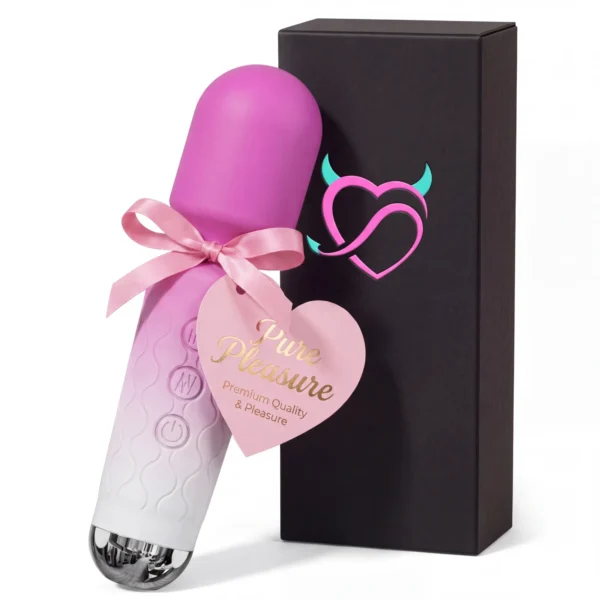
Original Wand Vibrator
Twenty modes, eight speeds, and a flexible silicone head that goes exactly where you want it. Whisper-quiet under 45dB, fully waterproof, and rechargeable for up to…
5Keeping a mental note of what worked
After each session, record three things: what you changed, what you noticed, and what you would repeat. Three lines is genuinely enough — anything longer becomes homework and stops happening by the second week.
The three-line note
- Changed: “lower setting, through a layer, slightly left of where I usually start.”
- Noticed: “built more slowly, stayed comfortable for much longer.”
- Repeat: “yes — try one setting higher next time.”
Make the note within a few minutes, in your phone or in your head. Detail fades quickly, and by the following morning you will remember that something worked without remembering the settings that produced it.
What not to record
Do not score sessions out of ten, and do not record how long anything took. Both convert an exploratory exercise into a performance review, and neither number gives you anything you can act on next time.
Preferences are also allowed to be inconsistent. A setting that worked on Tuesday and did nothing on Friday has not been disproved — it has simply met a different week.
Turning notes into a shortlist
After a month you will have something close to a specification: an intensity range, a rhythm type, a position, and whether you want a layer between you and the device. That specification is what makes shopping straightforward instead of overwhelming, and it is worth having before you spend anything.
If you would rather build up the background first, there are more getting started guides covering materials, cleaning and storage. When you are ready to test a specification, something like the Original Wand Vibrator is a common first choice, because a broad head suits indirect work and multiple settings let you move up in steps rather than jumps.
6Bringing that into a relationship
Translate your notes into plain, present-tense instructions rather than feedback: “slower, lighter, slightly to the left” works, whereas “that’s not quite right” does not. Specific direction is easy to act on and carries no implied criticism.
You are handing someone information they had no way of guessing. Framed that way, it is a generous thing to do rather than an awkward one.
When to say it
Outside the moment, at least the first time. A short conversation while washing up lands far better than a correction offered mid-encounter, which tends to be heard as a verdict however kindly it is phrased.
Once the general shape has been agreed calmly, small in-the-moment adjustments stop feeling loaded and start feeling normal.
How to frame it
- Lead with what you want more of, not with what you want stopped.
- Give one instruction at a time, for the same reason you change one variable at a time.
- Use ordinary words. You do not need clinical vocabulary or a borrowed euphemism to be understood.
- Open with “I’ve worked out that…” — it presents a discovery rather than a complaint that arrived late.
If a device is part of it
Say so beforehand rather than producing it unannounced. Framed as an addition — something that holds a rhythm no hand can sustain — it is far easier to introduce than if it appears mid-session and has to be explained on the spot.
Choosing it together also removes the guesswork, since you both end up knowing what the settings do. If that is the stage you are at, the full range is organised by type, so you can start from the specification you have already written rather than from scratch.
Find the one that suits you
Body-safe, beautifully discreet, and chosen with care.
Free UK delivery over £30 · 14-day returns on sealed items
Frequently asked questions
How long does it take to work out?
Most people get a usable sense of their preferences across five or six unhurried sessions spread over three or four weeks. The first one or two are largely lost to novelty and self-consciousness, so treat them as warm-up rather than data. Changing one variable at a time speeds this up considerably; changing several at once can stretch it out for months.
Is it normal to prefer indirect stimulation?
Completely normal, and very common. Preferring contact through a layer of fabric, through your own hand, or slightly to one side is a preference in its own right, not a stage you are meant to grow out of. If direct contact feels too sharp to enjoy, that is useful information about sensitivity rather than a problem to be corrected.
Does it change over time?
Yes, and it is normal for it to. What works can shift with sleep, workload, life stage, a new relationship, or simply familiarity with a particular rhythm. It is worth revisiting your notes every year or so rather than treating them as settled. If a medication you have started seems to coincide with a change, ask your GP or pharmacist.
Does stress affect it?
Many people notice that a busy, distracted week changes what they register and how long anything takes. That is an ordinary observation rather than a diagnosis. Practically, it means a stressed evening is a poor session to draw conclusions from — note the conditions and try again on a calmer day. For a persistent change that worries you, speak to your GP.
Do I need a sex toy to work this out?
No. Pressure, rhythm and location can all be explored without buying anything, and privacy plus unhurried time matters far more than equipment. A device is useful mainly because it holds a consistent rhythm that a hand cannot sustain, which makes comparisons cleaner. Plenty of people map their preferences first and buy afterwards, using what they learned as a specification.
What if nothing seems to work?
First check the basics: enough time, enough privacy, light contact rather than firm, and a layer of fabric before any high setting. Several sessions of nothing much is common early on and rarely means anything. If discomfort or pain is involved, or the picture has changed noticeably from what you are used to, that is a conversation for your GP.
Jessica
Jessica founded PurePleasure to make shopping for intimate wellbeing feel calm, discreet and genuinely helpful. She leads the brand’s body-safe-first approach and hand-picks every product in the range for skin-safe materials, plain packaging and quiet, thoughtful design. She writes and reviews our guides from real, hands-on knowledge of what we sell — never as medical advice. Where a question touches on health, she will always point you to your GP. All guides by Jessica →