Wand vs Rabbit Vibrator
 By Jessica · Founder · Last updated
A wand works externally only, using a broad head that suits almost anyone; a rabbit gives internal and external sensation at once, but only if its fixed shape matches your body. If you are not sure yet, the wand is the safer first purchase.
- A wand vibrator works externally only, using a broad head that spreads sensation across a wide area, so it does not depend on your proportions.
- A rabbit vibrator delivers internal and external sensation at once from a fixed frame, which only works if the roughly 5cm to 7cm gap between its arms matches your body.
- Independent motor control is the most useful feature on a rabbit vibrator and the one most often missing from budget models.
- Thrusting and rotating mechanisms add weight, noise and moving parts, so a vibration-only device is usually the quieter and longer-lasting choice.
- Use water-based lubricant with silicone devices, because silicone-based lubricant can degrade a silicone surface over time and leave it tacky.
- If you are buying your first device and are still working out what you respond to, an external-only wand is the lower-risk purchase.
1External vs internal and external
A wand is an external-only massager with one broad, softened head. A rabbit is a dual stimulator: an insertable section plus a shorter external arm, working at the same time. That structural difference is the whole of the wand vs rabbit vibrator question, and everything else follows from it.
Motors, materials, app control, price — all of it sits on top of that one choice. Get the structure right and the rest is preference. Get it wrong and no number of vibration settings will rescue it.
It also helps to know these are not two versions of the same product. They answer different questions. A wand asks how much external sensation you want and how easily you want to find it; a rabbit asks whether one particular shape fits you. Those are not the same decision.
What a wand actually is
A wand is a handle with a flexible neck and a rounded head. Sizes vary between models, so check the listing for overall length and head width. The design began life as a general body massager and the silhouette has never really changed.
That width is the point. Sensation is spread across a broad area rather than concentrated in one spot, so you do not have to aim precisely, and you can shift by a couple of centimetres without losing contact. If you have ever found small single-motor bullet vibrators too fiddly to hold in place, a wand solves that by being difficult to miss with.
Wands come in mains-powered and rechargeable versions. Mains models hold a constant intensity with no battery fade, which is why the format has lasted decades. Rechargeable ones vary widely in run time and charge time, so check the listing for both.
What dual stimulation means
Dual stimulation means one device delivering internal and external sensation simultaneously from a single fixed frame. The longer section sits inside, the shorter arm curves back to rest against the outside, and because the two are joined, they move together.
If the vocabulary is new, our explainer on what a rabbit vibrator actually is walks through the parts, and external versus internal stimulation styles covers why people respond so differently to each. For the wider picture, Types of Vibrators Explained maps every category in one place.
The appeal is easy to see: two sensations, one hand, no coordination needed. The catch is that a rabbit assumes your body matches a shape somebody else chose. A wand makes no such assumption, because it only ever meets the outside of the body.
2What a rabbit is trying to do
A rabbit is trying to hold two points of contact at once, hands-free, from a rigid or semi-rigid frame. It is a geometry problem as much as a motor problem: the device has to place two things in the right positions and keep them there while you move.
That is genuinely difficult engineering, and it explains almost every decision on a rabbit’s spec sheet.
Every rabbit on the market is a set of compromises between reach, angle, flexibility and weight. Make the insertable section longer and the external arm sits further back. Make the arm more flexible and it holds position less reliably. No design wins on all four at once.
Why two motors matter
Most rabbits carry two separate motors: one in the insertable section, one in the external arm. They are usually different sizes, because the two jobs are different. Internal sensation tends to be carried better by low-frequency rumble, while external contact often reads better as a lighter, faster buzz.
A single-motor rabbit is a compromise. The vibration travels through the whole frame, which means whichever end wants less intensity gets exactly the same as the end that wants more. If a listing does not clearly state two motors, assume there is one.
The independent-control question
Independent control means you can set the internal and external motors to different intensities or patterns. It is the most useful feature on a rabbit and the one most often missing at the budget end.
Without it, you are locked to one setting for both areas, and the two rarely want the same thing at the same moment. Two separate buttons, or two rows in an app, is the thing to look for — our comparison of app-controlled and manual controls covers how each approach handles multi-motor devices.
Thrusting, rotating and the third mechanism
Some rabbits add movement on top of vibration: a rotating shaft, a beaded section, or a Thrusting Rabbit Vibrator’s motorised in-and-out action. These are gear-driven rather than purely vibration-driven, and gears are heavier and louder than motors.
They also add failure points. A vibration-only rabbit has fewer moving parts than one with a thrusting mechanism, and fewer moving parts generally means a longer service life. Our full rabbit vibrator explainer goes through each mechanism in turn.
3Where rabbits go wrong
Rabbits fail on fit far more often than on power. The two arms are set a fixed distance apart at a fixed angle, and if that spacing does not match your body, the external arm simply never lands where it is supposed to.
The fixed-arm problem
On most rabbits the gap between the insertable section and the external arm is set by the design, and it is not adjustable. Some models use a softer, more flexible arm that bends a little; plenty do not.
When the fit is wrong, the outcome is predictable. The arm sits too high, too low or slightly off to one side, and you spend the whole time adjusting the handle instead of relaxing. No intensity setting fixes a positioning problem.
This is why fit-dependent devices make a poor first purchase. If you are still working out what you respond to, an external-only device teaches you something useful, whereas a badly fitting rabbit teaches you almost nothing. Our Best Vibrator for Beginners UK guide starts from exactly that principle.
Weight, noise and the second mechanism
A simple vibration-only rabbit often weighs somewhere in the 150g to 250g range. Add a thrusting or rotating mechanism and that can climb past 400g. Held at an angle for more than a few minutes, that difference is noticeable in your wrist.
Noise follows the same curve. A single motor hums; a gear-driven mechanism clicks and whirs. For reference, ordinary conversation sits at around 60 decibels, and a thrusting model in a quiet room is closer to that than most people expect. If you share walls, check whether the listing quotes a decibel figure at all — many do not, and silence in the specifications is rarely a good sign. Smaller Discreet and Travel Vibrators are usually the quieter option.
Buying the feature list instead of the feature
Ten patterns, three speeds and a rotating head look impressive on a product page. In practice, most people settle on two or three settings and never touch the rest.
A device with fewer, better-executed functions usually beats one with a long specification and a weak motor behind it. The same logic applies when weighing up suction and vibration stimulators: the quality of a mechanism matters far more than the number of mechanisms.
4Where wands go wrong
Wands fail on intensity and bulk, not on fit. A full-size mains wand can start at a level stronger than many people want at any point, and its lowest setting is often still firm.
Too much, too soon
Mains-powered wands were built for muscle massage and were never scaled down for smaller, more sensitive areas. If the first setting feels overwhelming, that is a characteristic of the design, not a fault in you.
Two things soften it. A folded towel or a layer of clothing between the head and the body reduces intensity without changing the device, and a silicone attachment cap does much the same. Our walkthrough on How to Use a Wand Vibrator covers both, along with comfortable starting positions.
Rechargeable wands generally begin lower than mains models and offer more steps between settings, so if intensity is your worry, that is the version to look at. A Wand vs Bullet Vibrator comparison is worth reading too, since a bullet delivers a much lighter sensation from a far smaller body.
Size, cable and storage
A wand is not discreet. At full length it does not vanish into a bedside drawer, and a mains model has to live near a socket — the cable decides which rooms are available to you.
Travel makes it worse. A mains wand with a UK plug is awkward to pack and unusable abroad without an adapter. If you are away from home often, smaller travel-friendly options are a more realistic second device than a full-size wand.
No internal sensation at all
This is the honest limitation, and it is worth stating plainly. A wand does one thing and does not pretend otherwise.
If internal sensation is what you are looking for, a wand will not provide it, however good the motor is. That is the single clearest reason to choose a rabbit instead — and the only one that really settles the argument.
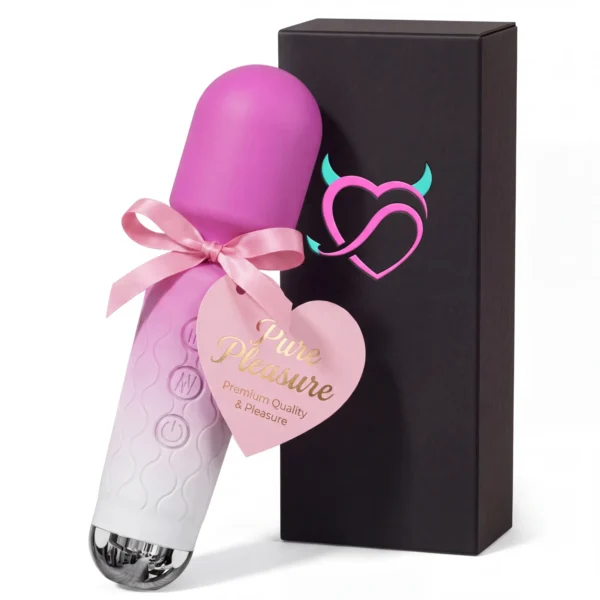
Original Wand Vibrator
Twenty modes, eight speeds, and a flexible silicone head that goes exactly where you want it. Whisper-quiet under 45dB, fully waterproof, and rechargeable for up to…
5Comfort and fit
Comfort comes down to three checkable things: measurements, material and lubricant compatibility. All three appear on a good product page, and all three are worth reading before you buy rather than afterwards.
The measurements worth checking
For a rabbit, four numbers matter: insertable length, insertable width, the gap between the arms, and total weight. The range is wide, and the figures are not interchangeable between models.
For a wand, only two really matter: head diameter and overall length. A smaller head gives more targeted contact, while a wider head spreads sensation further. Weight is worth a glance if you plan to hold it for a while.
If a listing publishes no measurements at all, treat that as missing information rather than a minor omission. Fit-dependent devices need dimensions. Working out which sensation you are actually aiming for first makes those numbers far easier to interpret.
Material and lubricant compatibility
Body-safe silicone is the standard for anything insertable: non-porous, straightforward to clean, and it warms to body temperature rather than staying cold. Rigid ABS plastic handles are common and perfectly fine, since they make no prolonged contact.
The compatibility rule is simple and frequently missed. Use water-based lubricant with silicone devices, because silicone-based lubricant can degrade a silicone surface over time and leave it tacky or pitted. Oil-based products should be kept away from silicone and from latex barriers.
Clean with warm water and a mild unperfumed soap, then dry fully before storing. Check the waterproof rating in the manual before submerging anything: a toy rated for immersion can go under water, while a splash-resistant one should only be wiped clean.
When discomfort is worth a conversation
Comfort should be the baseline, not the aim. If you experience persistent pain, unusual discomfort or bleeding — with a device or without one — please speak to your GP or a sexual health clinic. That is a medical question rather than a product question, and no guide, including this one, can answer it for you.
If all of this is new, starting with something gentle and external is the lower-risk route. Our starter picks for UK buyers are chosen with exactly that in mind.
6Which suits you
If you are unsure, choose the wand. It is the lower-risk purchase because it depends on nothing about your proportions, and it stays useful later even if you go on to buy a rabbit as well.
Choose a rabbit if you already know that internal sensation suits you and you want both at once from one device. That is a real, specific preference, and a rabbit serves it better than anything else does. It simply is not the default.
There is no universally better device here, and any guide claiming otherwise is selling you something. There is only which one matches your body, your home, and how much you want to think about the device while you are using it.
| Feature | Wand vibrator | Rabbit vibrator |
|---|---|---|
| Stimulation | External only, broad contact | Internal and external at once, fixed positions |
| Typical size | Long handle, broad rounded head | Shorter overall; insertable shaft plus external arm |
| Motors | Usually one, housed in the head | Usually two, sometimes plus a gear mechanism |
| Power | Mains or rechargeable | Almost always rechargeable |
| Depends on fit | No | Yes — arm gap and angle must match |
| Learning curve | Low; hard to miss with | Moderate; positioning comes first |
| Noise | Moderate, single motor | Higher on thrusting or rotating models |
| Typical weight | 250–500g, much of it in the handle | 150–250g, over 400g with a thrusting mechanism |
| Discretion | Low — large and recognisable | Moderate |
| Best suited to | Broad external sensation, shared use, first-time buyers | People who already know internal sensation suits them |
A quick way to decide
- Buying your first device: wand.
- Already own something external and want to add internal sensation: rabbit, with independent controls.
- Want something that doubles as an ordinary body massager: wand.
- Living somewhere with thin walls: vibration-only, not thrusting.
- Travelling frequently: neither at full size — look at a compact device instead.
- Shopping for shared use: wand, because it needs no fit match.
What about budget?
Budget deserves an honest mention. A well-made single-motor wand usually costs less than a dual-motor rabbit with independent controls, because it is a simpler machine with fewer things to get right.
If your budget stretches to one good device rather than two adequate ones, a simple device made well will outperform a complicated device made cheaply. That holds across every category, not just this comparison.
What to read next
If a wand is the sensible starting point, the Original Wand Vibrator is the straightforward version of the format: broad head, flexible neck, no extra mechanisms to go wrong. From there, more types and comparisons guides cover the remaining categories, a plain-language overview of vibrator styles works well as a single starting page, and you can browse the full range once you know what you are looking for.
Whatever you choose, buy the device that matches how you actually want to use it. The more complicated one is not the better one — it is just the one with more conditions attached.
Find the one that suits you
Body-safe, beautifully discreet, and chosen with care.
Free UK delivery over £30 · 14-day returns on sealed items
Frequently asked questions
Is a rabbit vibrator better than a wand?
Neither is better; they do different jobs. A wand gives broad external sensation and suits almost everyone, because nothing has to line up. A rabbit gives internal and external sensation at once, but only when its fixed arm spacing matches your body. If you are unsure which you prefer, the wand is the lower-risk choice.
Do rabbit vibrators fit everyone?
No, and that is the main reason people end up disappointed by them. The gap between the insertable section and the external arm is fixed, usually around 5cm to 7cm, and cannot be adjusted on most models. If the arm does not land where it should, no intensity setting compensates. Check the measurements before buying.
Which is easier to use?
A wand, comfortably. The head is broad, so precise aiming is unnecessary and small movements do not break contact. Controls are usually one or two buttons. A rabbit needs correct positioning first, then two sets of controls managed together, which is simply more to think about while you are trying to relax.
Can you use a wand internally?
No. Wands are designed for external use only, and the head is too broad and the neck too rigid for anything else. Using one internally would be uncomfortable and unsafe. If internal sensation is what you want, choose a device made for it, with a clearly defined handle and published insertable measurements.
How should I clean a wand or rabbit vibrator?
Wash with warm water and a mild unperfumed soap after each use, paying attention to seams and the join where a rabbit's two arms meet. Dry fully before storing. Check the waterproof rating first: IPX7 devices tolerate immersion in one metre of water for 30 minutes, while IPX4 models handle splashes only.
Are wands too powerful for beginners?
Mains-powered wands can be, since their lowest setting is often still firm. Rechargeable wands usually start gentler and offer more steps between levels, which makes them easier to get used to. You can also place a folded towel or a silicone attachment cap between the head and your body to soften the sensation.
Jessica
Jessica founded PurePleasure to make shopping for intimate wellbeing feel calm, discreet and genuinely helpful. She leads the brand’s body-safe-first approach and hand-picks every product in the range for skin-safe materials, plain packaging and quiet, thoughtful design. She writes and reviews our guides from real, hands-on knowledge of what we sell — never as medical advice. Where a question touches on health, she will always point you to your GP. All guides by Jessica →