Are Wand Vibrators Loud? What the Decibel Numbers Mean
 By Jessica · Founder · Last updated

Most wand vibrators run between roughly 45 and 70 decibels depending on the setting, which puts them below the level of normal conversation on low speeds and around vacuum-cleaner territory at maximum. Motor quality, housing material and what the wand is resting on matter far more than any number printed on a box.
- A wand vibrator on a low setting typically sits below the level of normal conversation, which is around 60 decibels at one metre.
- The decibel scale is logarithmic, so a 10-decibel increase represents ten times the sound energy and is perceived as roughly twice as loud.
- A decibel figure printed on packaging is meaningless without the test distance, the speed setting and the surface the device was resting on.
- Most noise that carries through a home is vibration conducted into hard furniture and floors, not sound travelling through the air.
- Silicone-covered bodies, balanced motors and snug-fitting attachments do more for quietness than any advertised decibel rating.
- No motorised device is truly silent, so treat the word 'silent' on a product page as marketing rather than measurement.
1How loud is loud, in real terms
Most wand vibrators measure somewhere between roughly 45 and 70 decibels depending on the speed setting, which places a quiet wand vibrator on its lower speeds well below the level of normal conversation. At maximum, the more powerful models sit closer to a kitchen appliance.
Those numbers mean nothing in isolation. What helps is seeing them next to sounds you already know.
| Sound source | Approximate level | How it reads in a quiet room |
|---|---|---|
| Whisper at one metre | around 30 dB | Barely registers |
| Fridge hum or a quiet library | around 40 dB | Noticed only when everything else stops |
| Wand on its lowest setting | around 45–50 dB | Audible nearby, lost under a fan or music |
| Normal conversation at one metre | around 60 dB | Clearly audible, easy to talk over |
| Powerful wand at maximum | around 65–70 dB | Obvious in a silent room |
| Vacuum cleaner at one metre | around 70–75 dB | Dominates the room |
The everyday reference points above are the standard figures used in acoustics comparison charts. The wand figures are typical published ranges rather than a like-for-like survey, because brands rarely measure to a common standard — a point worth holding on to for the rest of this guide.
For scale at the other end: the Control of Noise at Work Regulations 2005 set the lower exposure action value at 80 decibels, the point at which a UK employer must begin assessing hearing risk. Personal massagers are nowhere near that territory.
At the quiet end, the World Health Organization’s Guidelines for Community Noise recommend continuous background noise in bedrooms stay below 30 decibels for undisturbed rest. Almost no small motor achieves that, which is why "silent" is a marketing word rather than a measurement.
If the shape itself is new to you, What Is a Wand Vibrator? explains the long handle and rounded head design, and how it sits alongside the other vibrator styles on the market.
2What a decibel rating actually tells you
On its own, a decibel rating tells you very little, because measured volume depends entirely on the distance from the microphone, the speed setting used, and the surface the device was sitting on. Without those three details, the number is a claim rather than a measurement.
Very few brands publish their test conditions. A figure taken at one metre on the lowest setting, resting on a folded towel, will look dramatically better than the same device measured at 30cm on full power on a wooden table — and both are honest readings of different things.
Why 45 dB and 50 dB are further apart than they look
The decibel scale is logarithmic, not linear. Every 10-decibel increase represents ten times the sound energy, and most listeners perceive it as roughly twice as loud.
So a 55-decibel wand is not fractionally louder than a 45-decibel one. In a still room at night, it is a noticeably different experience.
Distance changes the answer
Sound pressure drops by about 6 decibels each time you double the distance from the source. A wand reading 60 decibels at 30cm is nearer 54 decibels at 60cm, and quieter again by the time it reaches a closed bedroom door.
Pitch matters as much as volume
Two devices measuring the same level can feel completely different. A low, broad hum blends into the background of a house; a thin, high whine cuts straight through it.
Deeper, rumbly motors tend to read as quieter at home even when a meter disagrees. That difference in character is also part of how the sensation feels, which our walkthrough of using a wand comfortably covers in more detail.
3Why cheap motors are the noisy ones
Noise in a wand is mostly a by-product of imprecision — parts slightly out of balance, slightly loose, or housed in something that resonates. Better tolerances cost more to manufacture, which is why price and quietness broadly track each other.
Where the sound actually comes from
- The weight itself. Most vibration comes from an off-centre weight spun by a small motor. If that weight is imprecisely cast, the wobble becomes audible.
- Bearings. Simple sleeve bearings are cheaper than ball bearings and develop play sooner, which turns into a whirr.
- Gearing. Any gear train adds a second source of mechanical noise on top of the motor.
- The housing. A hollow, hard plastic shell behaves like the body of an acoustic instrument, amplifying whatever the motor does.
- Fit. Loose seams, gaps around the neck and rattling battery compartments add buzz that has nothing to do with power.
This is where body-safe silicone earns its reputation twice over. Silicone moulded over the shell, rather than a thin sleeve slipped on top, absorbs vibration instead of broadcasting it — and it is far easier to keep clean, as our guide to caring for and charging a wand sets out.
Power and noise are not the same thing either. A well-engineered motor can deliver strong, deep vibration at a lower measured level than a weaker, rattlier one, which is why the loudest device in a drawer is rarely the most capable.
4Corded vs cordless noise
Mains-powered wands are usually the louder of the two, because a plug socket gives the motor far more headroom than a battery does. Cordless models are engineered around run time, and that constraint tends to keep them quieter.
The trade-off is consistency. A corded wand delivers the same output from the first minute to the last, while a cordless one can shift in both strength and tone as the charge drops — often sounding slightly higher-pitched near the end of a session.
Cables introduce their own small noises. A power adapter can hum faintly, and a cord dragging across a hard floor or bed frame adds sound that has nothing to do with the motor.
There is also the practical matter of where you can use one. A cordless wand can be used away from a socket, on soft furnishings, at a distance from shared walls — which in a flat is often worth more than a few decibels on paper. Our full comparison of cordless and corded wands weighs up strength, run time and convenience together.
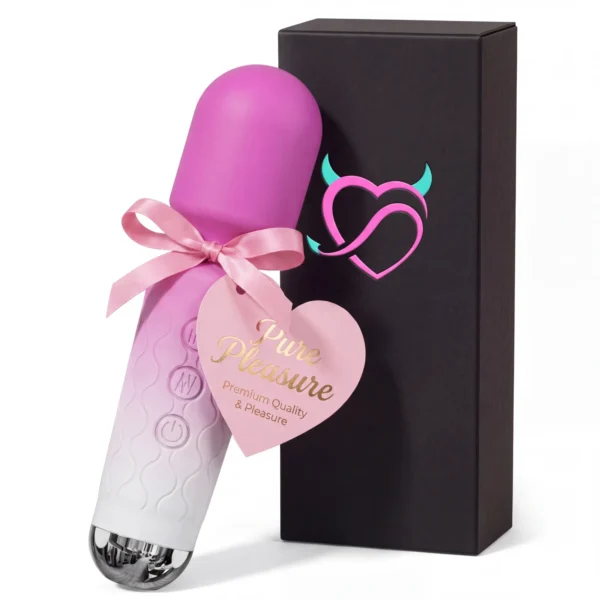
Original Wand Vibrator
Twenty modes, eight speeds, and a flexible silicone head that goes exactly where you want it. Whisper-quiet under 45dB, fully waterproof, and rechargeable for up to…
5Practical ways to muffle sound
The single most effective change is stopping the wand from touching anything hard. Most of what actually travels through a home is vibration conducted into furniture, floors and walls, not sound moving through the air.
A few adjustments that make a genuine difference:
- Keep it off the frame. Resting a wand against a headboard, bedside table or floorboards turns that surface into a speaker. A duvet, cushion or folded towel underneath breaks the path.
- Use the lower settings. On most wands the first two or three speeds are dramatically quieter than the top one, and the difference in sensation is smaller than the difference in volume.
- Add background sound. A fan, extractor, playlist or television at conversational level masks a 45-decibel hum entirely.
- Close the gaps. More sound escapes under a door than through it. A draught excluder or rolled towel at the threshold costs nothing.
- Choose a soft attachment. Silicone heads damp both the motor and any contact noise. Wand Vibrator Attachments Explained covers which types fit which handles.
- Check the fit. A rattle is usually a loose attachment or a partly closed cap, not the motor.
If you are new to all of this and the worry is mostly about being overheard, our beginner’s introduction to wands works through the practical side without assuming any prior knowledge.
6What to check before you buy
Look past the advertised decibel figure and check five things: the housing material, the motor description, the number of low settings, whether attachments fit snugly, and whether the brand states any test conditions at all. Those tell you more than a single number ever will.
A short pre-purchase checklist:
- Silicone over the body, not just the head — it damps vibration and cleans easily.
- A described motor. Brands that mention rumbly, low-frequency or deep vibration are usually describing a better-balanced motor than those quoting speed counts alone.
- Useful low settings. Ten speeds are no help if the first usable one is already loud.
- Stated test conditions. Any brand publishing distance and setting alongside a decibel figure is being unusually straight with you.
- Rechargeable, sealed construction. Fewer removable parts means fewer things to rattle later.
- A returns policy you have actually read, since hygiene rules limit returns on intimate products in the UK.
For a longer-form version of this checklist, Best Wand Vibrator UK: A Buyer’s Checklist works through build quality, power and warranty side by side, and there are more wand guides covering attachments, care and first use.
When you are ready to compare specifications rather than read about them, you can browse quiet wand vibrator options across the range, or look at the silicone-covered Original Wand Vibrator as a reference point for what a well-damped body feels like in the hand.
One last thing worth saying plainly: if concern about noise is part of a wider worry about comfort, sensation or your body, your GP or a local sexual health clinic is a far better place to ask than any product page.
Find the one that suits you
Body-safe, beautifully discreet, and chosen with care.
Free UK delivery over £30 · 14-day returns on sealed items
Frequently asked questions
What decibel level counts as quiet?
In practice, anything at or below about 50 decibels reads as quiet indoors — that is under the level of normal conversation, which sits near 60 decibels at one metre. Below 40 decibels is genuinely discreet, roughly a fridge hum. Remember that no motor is silent, and any figure depends on distance and setting.
Can someone hear it through a wall?
Usually not, if it is running on a soft surface rather than against furniture or a shared wall. Airborne noise loses roughly 6 decibels with every doubling of distance and is absorbed further by plasterboard, bedding and closed doors. What does travel is vibration conducted through solid structures, so keep it off the headboard and floor.
Does a higher speed mean more noise?
Almost always, yes. Faster motor rotation moves more air and raises the pitch, and pitch is what makes a sound noticeable. The jump is rarely even, though: many wands are barely audible on their first two settings and climb sharply on the top one. If discretion matters, test the highest setting you actually intend to use.
Are silicone heads quieter than plastic?
Generally yes. Silicone is a soft, dense material that absorbs vibration instead of transmitting it, while hard plastic shells can act like a sound box and amplify the motor. A silicone head also dampens the noise made when the wand touches a surface. Look for silicone moulded over the body, not just a thin sleeve.
Do wand attachments make it louder?
They can, slightly. A rigid attachment adds a surface for the motor to vibrate against, which sometimes introduces a rattle if the fit is loose. Soft silicone attachments usually make no audible difference, and a snug fit matters more than the material. If you hear a new buzz, check the attachment is fully seated.
Why has my wand got louder over time?
A change in sound usually points to something mechanical rather than anything you did wrong. A low battery, grit around the neck of the head, a loose attachment or a dried-out seal can all add rattle. Clean and dry it properly, charge it fully, and if the noise persists, contact the manufacturer under warranty.
Jessica
Jessica founded PurePleasure to make shopping for intimate wellbeing feel calm, discreet and genuinely helpful. She leads the brand’s body-safe-first approach and hand-picks every product in the range for skin-safe materials, plain packaging and quiet, thoughtful design. She writes and reviews our guides from real, hands-on knowledge of what we sell — never as medical advice. Where a question touches on health, she will always point you to your GP. All guides by Jessica →